A brief history of Compton by Barbara Clegg.
Printed in the Compton & Shawford Parish Magazine, November 1955
and placed in a time capsule to be opened in 2005.
I am very grateful to Mrs. Clegg for writing the main part of this issue of the magazine; you will agree that it is an admirable summary of the history of the parish, and the title she has chosen for it goes to the heart of the matter.
We have indeed ” A Goodly Heritage”; how fortunate we are! and how thankful we should be!
God bless you all.
Your sincere friend and Rector,
H. M. J. BURDETT.
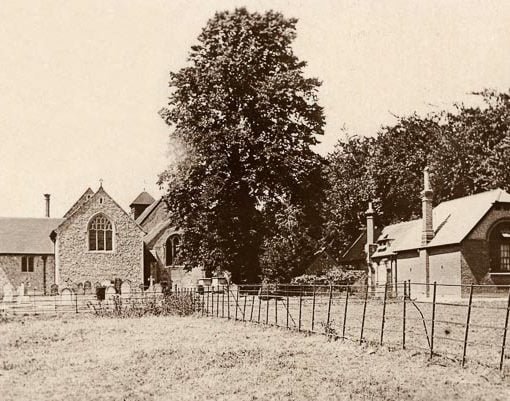
Image from Hampshire Record Office, ref IM76/PZ8/22/11
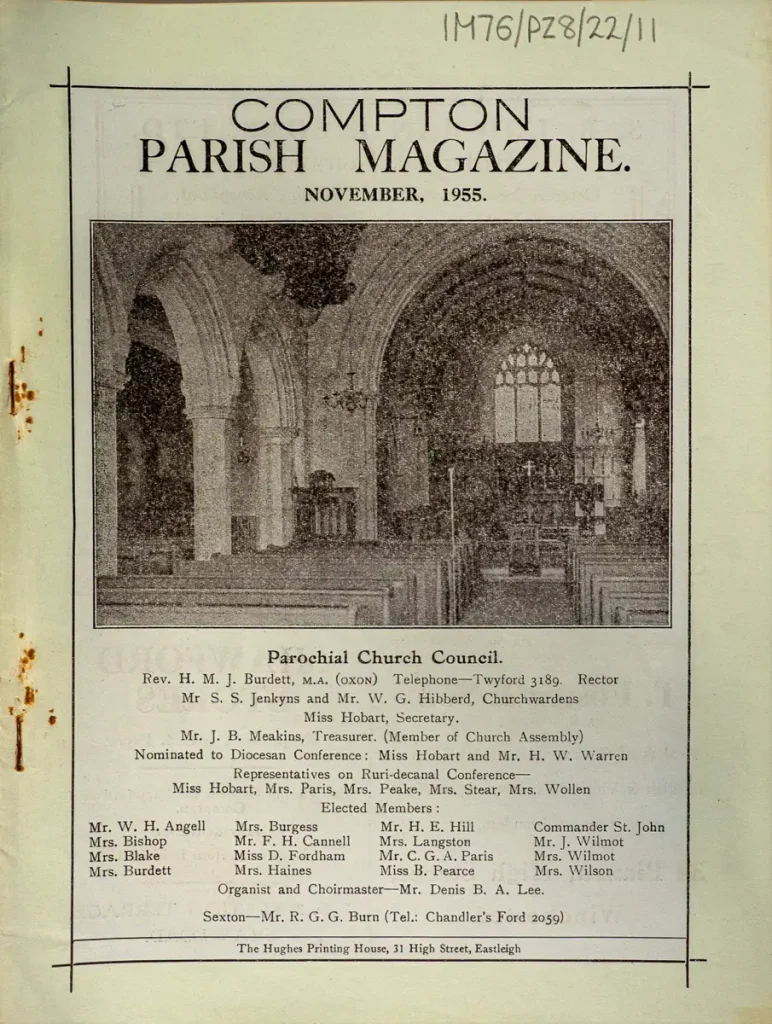
A GOODLY HERITAGE
In the year 643, Kinewalc, the Christian king of the West Saxons, gave the land for seven leagues round his royal city of Winchester to the Church for ever more. Compton, (“the village in the valley”), was part of this gift, together with the tiny hamlet of Shawford, (the “shallow ford”), and Silkstede, (the “farm steading” of some forgotten Celt). Thus the great Benedictine Priory of St. Swithun, entrusted with the custody of Winchester Cathedral, became the landlord of this village.
During the early middle ages some forty families lived in the valley, farming their holdings as tenants of the Priory, paying their rents by work on the land or by produce (one tenant had to provide a measure of strawberries every St. John the Baptist’s Day). A freeholder, Nicholas Wascelyn, paid his rent wholly in money, and was of such importance that the village was known as “Compton Wascelyn” for many years. At Silkstede the Priory had a home farm, to supply food for the monks and their guests.
In Anglo-Saxon times a small wooden church was built on stone foundations, but in 1155 this was replaced by a church of stone and flint, and it is this church, dedicated to All Saints, whose foundation we commemorate on November 1st. It now forms the northern part of the present church.
In 1340 the Black Death swept over England, and in Compton, as elsewhere, the death toll was heavy and the holdings became derelict. The Priory offered the empty fields for a money rent to any who would take them, and a succession of enterprising tenants began to farm here. Chief of these was John Philpott. His descendants lived and farmed in Compton for over two hundred years – a quarrelsome, acquisitive family, but a prosperous one. They built the house known as Compton Place, and seem to have been responsible for putting two windows in the chancel of the church. During this period, the farm at Silkstede was let to secular tenants, at least two of whom were women, and a comfortable house was built for the Prior alongside the farm buildings.
When Henry VIII dissolved the Priory, a new corporate body, the Dean and Chapter, took charge of the Cathedral and became the Compton landlord. The parish experienced the usual doctrinal ups and downs of the age. Several families (notably the Philpotts and the Beanes) refused to accept the Church of England “as by law established” under Elizabeth I, and paid heavily in fines for non-attendance at church. During the Civil War, the Philpott of the day joined the King’s party, and later was forced to sell his estate in Compton to pay for taking the wrong side. The tenant at Silkstede at this time was John Harris; one Richard Goldfinch farmed the western corner of the parish – both these families lived in Compton for about 250 years, and their names appear frequently in the registers which began in 1669.
During the eighteenth century a new farm, New Barn, appears in the records, made from a combination of the Silkstede lands and some of the Philpott fields (Mr. E. T. Judd, the present owner, is the twenty-sixth freeholder since Nicholas Wascelyn). William Heathcote of Hursley bought the rest of the Philpott estate, thus beginning a connection with the parish that still exists. From this century date two beautiful buildings – the house, hitherto known as the “old” Rectory, and the Parsonage barn, now refitted as farm buildings. A gallery was placed at the west end of the church to accommodate members of the twenty-five households which made up the parish. The village had a blacksmith, a cobbler, and an inn, the “Chequers”; a malthouse stood on the site of the present Bridge Inn, and near it, a poor house.
The nineteenth century gave us one of the best-loved Compton Rectors, Philip Williams. Although at first an absentee, he came here to live after the early death of his wife Sally, and Compton has had a resident rector ever since. A village school was built through the generosity of the Heathcote family, and Charles Wickham (Rector 1871-1902) made great improvements inside the church. The gallery was taken down, windows cleared, and plaster removed from the chancel walls, revealing part of a fresco and a long-forgotten window. The east window was re-glazed, a gift of Philip and Sally Williams’ grand-daughter.
In 1882 a railway-station was opened at Shawford, on the main London-Winchester-Southampton line. Easy means of transport brought a residential class to the village, as well as families who were employed on the railway. The Ecclesiastical Commissioners (who had replaced the Dean and Chapter as our landlords in the mid-century) now sold the land in the south-west of the parish for housing purposes (Southdown) and other houses were built near the river.
In 1801 there were 225 people in the parish; by 1901 there were 555. The old church could seat but 70, so in May 1905 the church was extended under the careful supervision of two parishioners, Mr. Colson and Mr. Kitchin, both architects. A second chancel was added, and the south doorway, a piscina and other stone work from the old church was incorporated into the south wall of the new building, which was consecrated by Herbert Ryle, Lord Bishop of Winchester, on the Eve of All Saints’ 1905.
The two great wars took their toll of Compton men, but the village itself escaped damage, by the mercy of God. A stone cross on the Downs serves as memorial to the dead of the two wars, and a smaller cross – “the Wayside Cross” – nearer the main road marks the first stop out of Winchester for the troops who marched to the trenches in France.
In 1938 Compton found itself to be the southern extremity of the Winchester bye-pass, and a series of multi-lateral roads considerably altered the lie of the land. Another revolutionary change occurred in 1953 when the Compton farm, built into one compact holding by many farmers during the past five hundred years, with Mr. Wilfrid Godwin as its latest and last tenant, was bought from the Church Commissioners by the County Council, and divided into twelve small holdings. At the same time, some of the fields at the north-western end of Compton street were set aside for additional council houses and flats.
The old Compton folk might be a little puzzled could they see their village as it is to-day. But one would like to think that their returning shades would find their way to the little church that they knew so well, and, kneeling where we kneel, thank God as we do for a lot cast “in a fair ground”, a “goodly heritage”.
B.M.C