Table of Contents
John Philpot
Compton’s martyr, John Philpot, had a colourful career and crossed paths with many other characters with interesting and unusual stories, as we shall see.
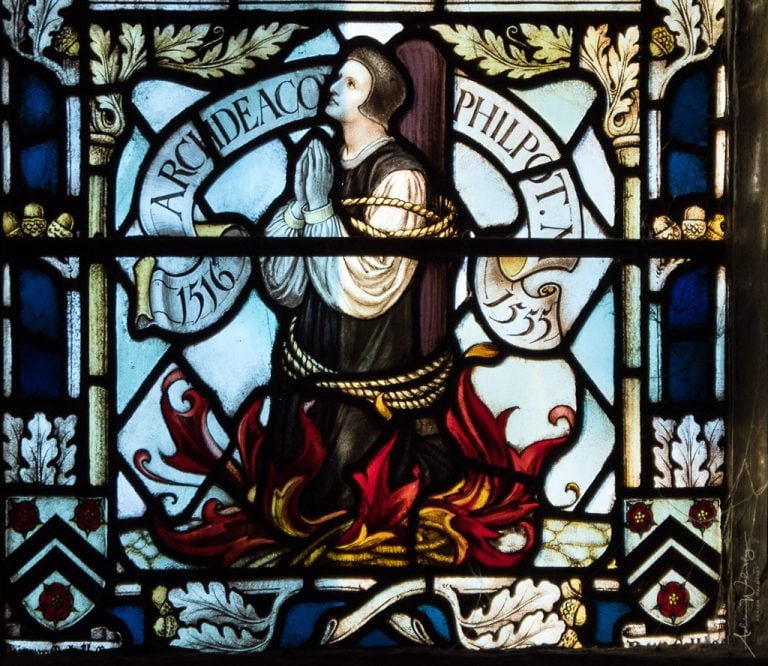
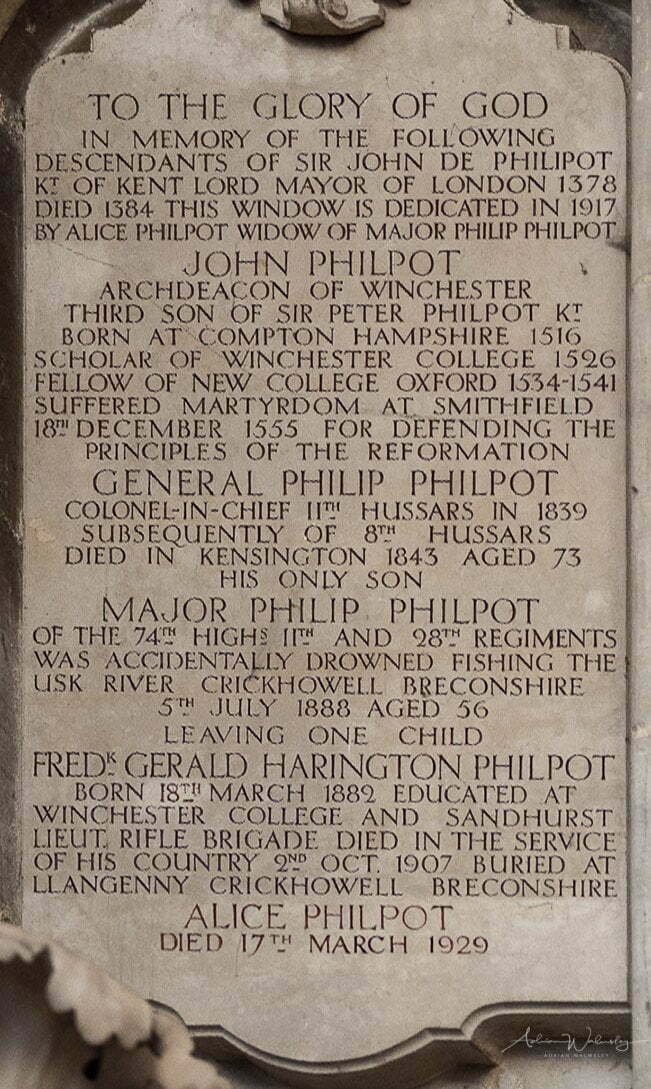
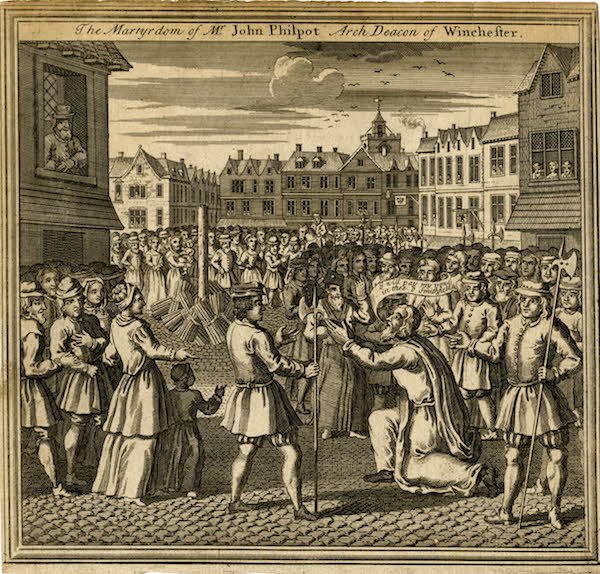

JS Drew writes:
Whitaker writes:
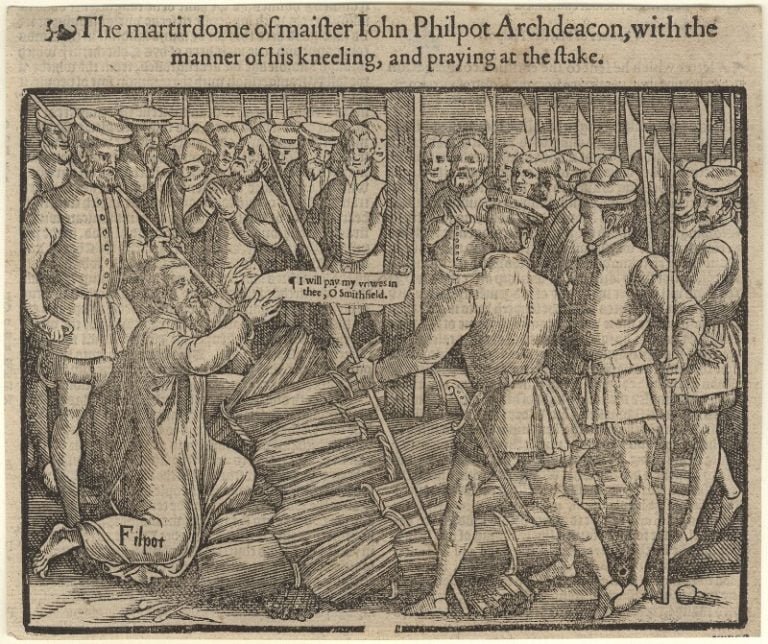
John Philpot – Archdeacon of Winchester and Martyr – abstract of paper by Andrew Payne
Included is an outline of his trial from which it is shown that he was promised the position of archdeacon by the ultra conservative bishop of Winchester, Stephen Gardiner.
Evidence is also provided from the trial and from his family, contrary to the opinion of Muriel St. Clare Byrne, that he was not related to Clement Philpot who was executed in 1540.
A transcript translation of his father’s will is provided giving a good indication of his family circumstances.
This will was drawn up in 1540 at a pivotal point in English law when, in order to overcome the default position of inheritance through primogeniture, the rules of will writing were altered.
This will was written to abide by the rules that existed before the new Statute of Wills was passed by Parliament, and, also, to abide by the new rules set out in the Statute.
From this will and other evidence a new genealogy of the Philpot family down to the 1650s is provided.
The authenticity of the so-called portrait of John Philpot held at Winchester Cathedral is also discussed.
For full paper see John Philpot – Archdeacon of Winchester and Martyr (1515–1555) by Andrew Payne
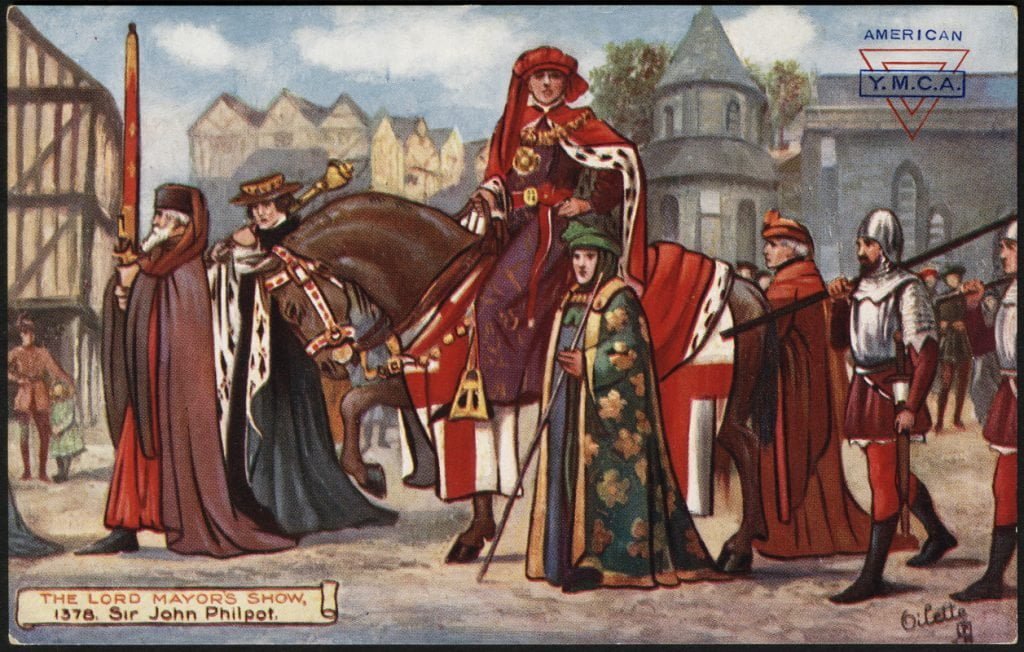
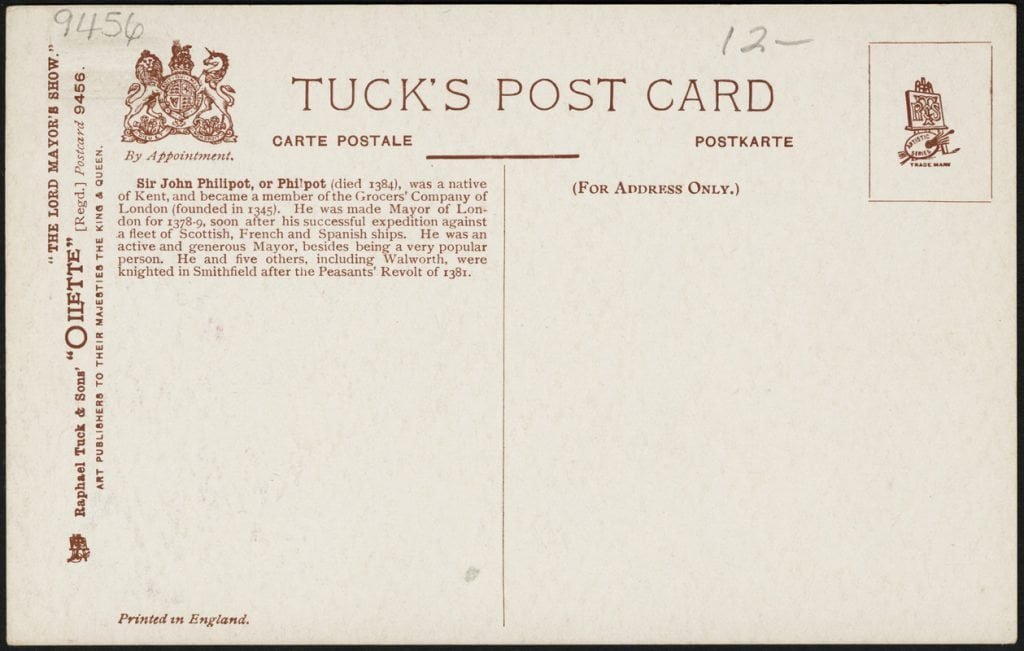
The Hampshire Philpots trace their ancestry to Sir John Philipot, (d. 1384), a successful wool merchant, mercer and alderman of London. He had probably been born in the Isle of Grain on the Medway, around 1330.
He married three times, to women of high social status and wealth.
He was elected to parliament several times between 1369 and 1383, and sheriff in 1372-3. He was chosen to advise the King’s Council on how to protect merchant shipping in the war against France. This would have included trade with Calais, which had been under English rule since its capture by Edward III in 1347.
For 12 years from 1374 Geoffrey Chaucer held the lucrative job of Comptroller of Wool Customs for the Port of London. He would have known Philipot and two other influential merchants, William Walworth and Nicholas Brembre who were Collectors at the port during that time. All three would become Lord Mayor.
Such was his standing within royal and court circles as well as merchant ones, by 1377, that Philipot led the successful opposition to John of Gaunt’s plan to suspend the mayoralty and place the government of London in the hands of Henry Percy, Constable and Marshal of England.
In 1377, when 14 year-old Richard II acceded to the throne on the death of his grandfather Edward III, Philipot led a deputation from the City to assure the new king of their loyalty. He also sought conciliation with John of Gaunt, Duke of Lancaster.
In 1376 John Mercer, a wealthy Scottish merchant and friend of the French king, had been shipwrecked off the coast of Northumbria. His merchandise was seized, and he was imprisoned in Scarborough Castle. Although Mercer had been released unharmed in 1377, his son Andrew sought retaliation in 1378. He assembled a fleet of Scottish, Flemish and French privateers which attacked and plundered the town of Scarborough and captured the English ships in the harbour.
John Philipot led a daring raid by fitting out and equipping, at his own expense, a small squadron of ships and a thousand armed men who recovered the ships and booty, and also captured fifteen Spanish merchant vessels.
This unauthorised expedition did not go over very well with the noblemen of the day, who complained to the King that he was usurping his power, but its popularity with the people led to his election as Lord Mayor of London for 1378–9.
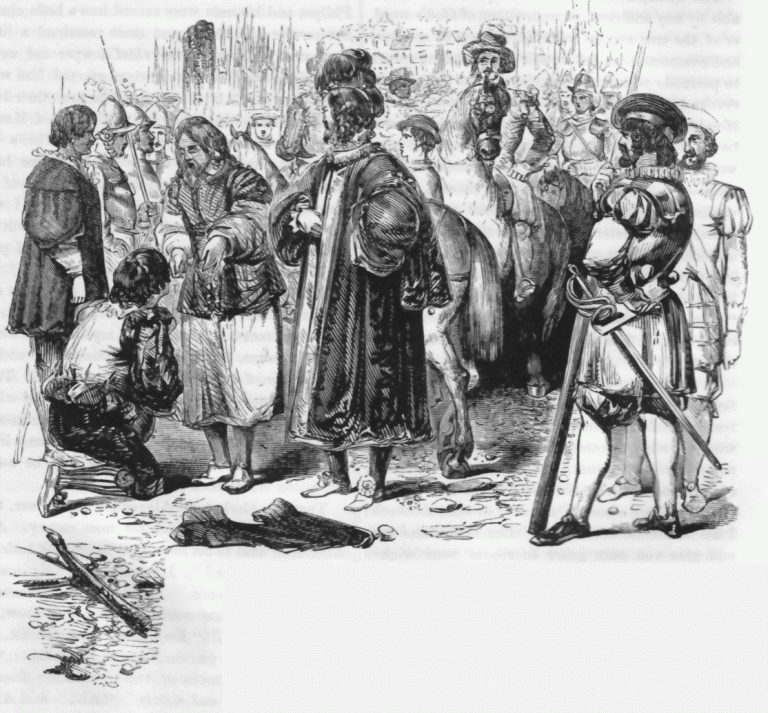
In June 1381 Philipot, along with Walworth (then Lord Mayor) and Brembre, and one Robert Launde were knighted on the spot by Richard II for their part in bringing the Peasant’s Revolt to an end with the death of its leader, Wat Tyler. Tyler had tried to stab Walworth, who was saved by his chain-mail; Walworth struck back and although his blow may or may not have proved fatal, Tyler was caught and beheaded.
Philipot’s generosity included lending money to the crown, providing ships for and funding the Earl of Buckingham’s expedition to Brittany, building one of the two 60ft stone towers erected in the Thames to defend shipping, and leaving property for the benefit of the City of London.
He died in 1384 and was buried in Christ Church, Greyfriars. Only the most important citizens or those with royal blood were buried there.
In the early 14th century, an impressive new church had been built on the site of the 12th century Franciscan monastery. The new church was the second biggest church in the City of London, with its own university and library.
Greyfriars church was destroyed in the Great Fire of London in 1666; it was replaced by a smaller church as part of Sir Christopher Wren’s rebuild of the City. It was almost completely destroyed again in the Blitz. The tower and some walls still stand and the site is now a memorial garden.
The Philpot Family
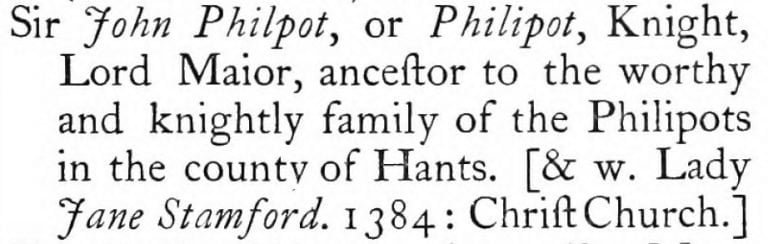
The inscription on Sir John Philipot’s tomb confirms him as the ancestor of the Hampshire Philpotts.
The chain of descendants which leads to Archdeacon John Philpott can be found on various genealogy websites, and on the 1620 illustrated Philpot family tree in the Hampshire Archives, but details seem to be vague and in some places are definitely incorrect.

- Sir John Philipot, Lord Mayor of London, 1330-1384 b. Kent, d. London
- Sir John Philpot, “Knight of Compton”, b. 1370
- Sir John Philpot, Sheriff of Hampshire, 1430-1484
- John Philpot, Sheriff of Hampshire, 1460-1502, b. Compton Hants
- Sir Peter Philpot, Sheriff of Hampshire, 1488-1540, b. London, d. Compton Hants
- Archdeacon John Philpott, 1515-1555, b. Compton, Hants, Martyred at Smithfield
Drew states
The Philpotts were descended from Sir John Philpott who was Lord Mayor of London in 1378, and they held land also in Pitt, Durley, Bishopstoke and near Lymington, as well as manors in Middlesex and Herts and much house property in the city of London.
This was the first time that a really wealthy family had come to Compton and one wonders at what period they built the house at Compton Place which was eventually pulled down at the beginning of the 18th century.
We shall find that the earlier Philpotts had many virtues, but that regard for the rights of other people was not one of them.
John Ponet (c. 1514–1556) was a prominent English Protestant reformer, scholar, and clergyman who served as the Bishop of Winchester during the reign of King Edward VI. He is best remembered for his radical political theories and his defense of clerical marriage.
Life and Career
Born in Kent, Ponet was educated at Queens’ College, Cambridge, where he became a distinguished humanist scholar, excelling in Greek, mathematics, and astronomy. A sundial of his design even stands at Queens’ College today. He rose quickly in the church as a protégé of Thomas Cranmer, Archbishop of Canterbury, serving as Cranmer’s chaplain before being appointed Bishop of Rochester in 1550 and in 1551, after Bishop Stephen Gardiner had been deprived, Bishop of Winchester.
Ponet was a controversial figure for his time, notably for his open advocacy and practice of clerical marriage. He married twice, famously having to “buy out” his first wife’s pre-existing marriage contract before marrying Maria Hayman in 1551.
Political Influence and Exile
Following the accession of the Catholic Queen Mary I in 1553, Ponet was deprived of his bishopric. He is believed to have participated in Wyatt’s Rebellion against the Crown before fleeing to Strasbourg as a Marian exile.
While in exile, he published his most influential work, A Shorte Treatise of Politike Power (1556). In this text, he argued that the power of a monarch is derived from the people and that a tyrant could be justly deposed or even executed. This “resistance theory” is considered a foundational text in the development of modern constitutionalism and influenced later thinkers such as John Locke.
Legacy and “Bishop’s Gin”
Ponet’s legacy has recently been celebrated by his descendants. Thierry Ponet, a direct descendant based in Belgium, launched Bishop’s Gin (by Ponet Spirits) as a tribute to his ancestor’s rebellious and pioneering spirit. The gin is a London Dry style, featuring botanicals like nasturtium and lemongrass, and its branding often features an “eerie” illustration of the Bishop. The family’s history in distilling dates back to the 1763 Ponet distillery in Hasselt, which Thierry has revived by bridging the Bishop’s English heritage with the family’s Belgian craftsmanship.
to come
to come
to come
to come
References
- General
- Oxford Dictionary of National Biography – free access if you have a Hampshire Library card
- Compton near Winchester – being an Enquiry into the History of a Hampshire Parish; J S Drew, published 1939 by Warren and Sons, Winchester
- Compton & Shawford, by Austin Whitaker, ©1985, Published by Barbara Large & Austin Whitaker
- Winchester Cathedral Stained Glass, Mary Callé. Published by the Friends of Winchester Cathedral.
- Lives of Eminent and Illustrious Englishmen, from Alfred the Great to the Latest Times, edited by George Godfrey Cunningham, Vol I 1836, Vol II 1837. Available as an ebook from Google Books, and in hard copy from various sources.
- A History of England in the Lives of Englishmen, Edited by George Godfrey Cunningham, vol. I 1853. Also available as an ebook from Google Books, and in hard copy from various sources.
- Archdeacon John Philpot
- John Philpot – Archdeacon of Winchester and Martyr (1515–1555) by Andrew Payne
- John Philpot, Wikipedia entry: https://en.wikipedia.org/wiki/John_Philpot
- Foxe’s Book of Martyrs John Philpot
- The Examinations and Writings of John Philpot, B.C.L. Archdeacon of Winchester, from Google Play Books
- Christianity.com: Because John Philpot Didn’t Run, He Burned
- Philpot, John (DNB00)
- Sir John Philipot
- Philipot, John (d.1384) (DNB00)
- British History Online : Calendar of Letter-Books of the City of London: H, 1375-1399 – Introduction
- British History Online: the Borough of Scarborough
- The Chronica Maiora of Thomas Walsingham, 1376-1422
- Mercer Millions website: Sir Andrew Mercer
- The Old Scots Navy on Mercer
- Delphi Classics: The Complete Works of Geoffrey Chaucer
- Wikipedia List of Lord Mayors of London
- Geni.com Sir John Philpot, Lord Mayor of London
- Catalogue of the tombs in the churches of the city of London, A.D. 1666. By Major Payne Fisher, B.A
- Sir Richard (Dick) Whittington
- Bishop Stephen Gardiner
- Bishop Edmund Bonner
- Bishop John Ponet (or Poynet)